Saturday, March 22, 2014

A Bridge for Passing

The Columbia-Greene Partnership Academy, a.k.a. The Bridge, opened at 364 Warren Street on February 3. On Thursday, March 20, Tom DePietro interviewed Bruce Potter, superintendent of the Berkshire Union Free School District, a key player in The Bridge, on his WGXC radio show We the People. The interview is now archived and can be heard here.

Listening to the interview requires a fairly high comprehension of acronyms and eduspeak, but here are some salient facts of general interest. There are now 45 to 46 students being taught at this facility, from the Hudson City School District and the Catskill Central School District. Of those, 31 are enrolled in the Alternative Transition Program, meant to help at risk students graduate; the rest are special education students who previously would have been transported by bus to Canaan to attend classes. According to Potter, not having to transport students to Canaan saves from $40,000 to $60,000 a year.

The Bridge will operate at 364 Warren Street through the end of the next school year, in other words, until June 2015. June 2015 is also when Tom Gavin, building principal for The Bridge, will retire. In the meantime, the creators of The Bridge--Potter, HCSD superintendent Maria Suttmeier, and CCSD superintendent Kathleen Farrell--are "working with the Galvan Foundation to determine an appropriate location." According to Potter, the current building "maxes out" at 60 students, so they are looking for a new location that would have space for "a community room and a couple more classrooms" and some outdoor space. The building will be one that Galvan owns. 

Potter indicated that "Berkshire has relationships with Northern Dutchess schools," and it seems that students from these school districts--whether special education or ATP students or both wasn't clear--might be included in the program "if the location is appropriate."

When asked if, six weeks in, he was happy with the program's effectiveness, Potter said, "Happy is an understatement." The students' progress reports are outstanding, and attendance has been excellent.

On Thursday, April 3, from 2:30 to 4:30 p.m., there is to be a "Meet the Bridge" event for the public. Students in the program will be giving tours and making presentations, and there will be refreshments, catered by The Cascades. Those interested in attending must make their intentions known by contacting Melissa Daley at Berkshire Farm.
COPYRIGHT 2014 CAROLE OSTERINK

A Cemetery Mystery Solved

On Monday, Gossips asked the question, "Who is buried in Jones' tomb?" Today, we have the answer: Fred W. Jones himself, along with his daughter, Mabel Jones Hoffman, and two other people whose presence in the Jones mausoleum inspires further questions.

As Gossips reported previously, on June 17, 1901, the Hudson Daily Register ran the story that body of Fred W. Jones was missing from his mausoleum. The next day, on June 18, 1901, the Register followed up with an explanation of what had happened. Apparently, Fred W. Jones, the owner of the New York Coral and Shell Marble Company and creator of the "mountain railroad" from the quarry to the river, which bisected South Bay and evolved into the now controversial "causeway," had, by the time of his death on January 7, 1901, at the age of 59, fallen into financial difficulties. In December 1900, just a month before his death, Jones had gone bankrupt. 

The census records for 1900 indicate that Jones's home was mortgaged, and presumably the grand mausoleum he had built for himself in 1884, at a cost of $10,000, was mortgaged, too, because, in June 1901, the bank repossessed it and removed Jones's remains. According to the newspaper account, the bank put the casket and the body in another vault, but which one is not indicated. 

Cemetery records show that, in November 1902, Fred W. Jones was interred in Section 18-H, Plot 91--an individual grave--almost a year and a half after he'd been evicted from his mausoleum. If Jones was buried in the ground somewhere in the cemetery, who was buried in Jones' tomb? 

On Thursday morning, I accompanied Paul Barrett, Gossips' favorite collaborator in cemetery sleuthing, up to the cemetery to find out. Our first stop, before keeping an appointment with Gail Grandinetti in the cemetery office, was the Jones mausoleum, where peering through the iron gate into the crypt, we could see that there were four people entombed there: Mabel Jones Hoffman, Fred W. Jones, Frank Shults, and Mary Shults.

         
Mabel Jones Hoffman we know is Fred W. Jones's daughter, who was still a teenager when her father died, but who were Mary Shults and Frank Shults and why are they in Jones's mausoleum?

At the cemetery office, we learned from Gail Grandinetti that Jones's daughter had managed to pay off the debt and reclaim the mausoleum. Cemetery records show that in 1911 Jones was disinterred from Plot 91 in Section 18-H, and the plot was sold to Maria Miller, who is now buried there. At this point, ten years after his death, the body of Fred W. Jones was moved to its intended resting place.

That leaves the question of Mary Shults and Frank Shults. In the census records for 1900, the year before this death, Fred W. Jones is listed as a widower and the head of a household that includes Mabel Jones "Daughter," Mary Shults "Housekeeper," and Frank Shults "Clerk Office."

The records from the next decennial census, in 1910, nine years after Fred W. Jones's death, show a different and puzzling household configuration. In 1910, the head of household is William R. Pierce and the other members of the household are, in order of appearance, Ada "Wife," Elsie "Daughter," Andrew M. "Son," Jefferies Hochlander "Boarder," Mary Shults "Boarder," Frank Shults "Son," and Mabel Jones "Daughter." The order of entries seems to suggest that Mabel Jones, born the daughter of the rich and influential Fred W. Jones, is now, at the age of 25, being identified as the daughter of her father's former housekeeper, living with her as a boarder in her own home.

The story continues. On New Year's Day 1914, Mabel Jones, then nearly 30, married Harry Hoffman. In the report of the wedding, which appeared the next day on the front page of the Daily Register, the bride is identified as the "daughter of Mrs. Mary Jones and the late Fred W. Jones." Is Mrs. Mary Jones actually Mary Shults? 


If the names Mary Shults and Frank Shults sound familiar, here's why. In 1917, Frank Shults, executor of the will of Mary Shults, his mother, sued the New York & New England Cement and Lime company "not only to obtain damages for personal and real estate injuries, but to restrain the cement company from further commission of a nuisance." One of the plaintiffs in the lawsuit was Mabel J. Hoffman.

During the trial, Mabel Hoffman (née Jones) testified at length about the deplorable conditions in her mother's house caused by the operation of the cement plant. The newspaper accounts of the trial identify Mary Shults as Mabel Hoffman's mother and Frank Shults as her brother. They also reveal that in 1917 Mabel and her husband, Harold (Harry) W. Hoffman, along with Frank Shults, were living on the Jones estate, located on the south side of Route 9 just beyond Ten Broeck Lane--property Fred W. Jones had acquired in 1881. Orphaned at the age of 16, Mabel Jones seems to have adopted her father's housekeeper and the housekeeper's son as her de facto family, which would explain the presence of Mary Shults and Frank Shults in Fred W. Jones's mausoleum.

There is an afterword to the story. Although her husband seems at some point to have decamped to Buffalo, Mabel Jones lived in her father's house until her death in 1958. An article that appeared in the Chatham Courier on June 5, 1958, reports the "methodical destruction" visited on the house by vandals a few months after Mabel Jones's death. The account of what was destroyed suggests that in spite of her father's bankruptcy and her marriage to a machinist, probably considered marrying beneath her station, Mabel managed to retain the trappings of wealth. (Of course, Henry Ford started out as a machinist, so who knows what Harry Hoffman may have achieved?)

Once upon a time, I'm told, the Chatham Courier had a reputation for inaccuracy, and this article certainly supports that. Fred W. Jones was not a "pioneer in Hudson's cement industry." In fact, when the cement plants opened (the one adjacent to his property opened in 1910), Fred Jones was already dead. He died in 1901, not in the 1920s as the article would have it. Also, Mabel Jones was Fred Jones' daughter not his wife.
COPYRIGHT 2014 CAROLE OSTERINK
Thanks to Paul Barrett, Gail Grandinetti, Chad Weckler, and Timothy O'Connor for the information they contributed to this post

Friday, March 21, 2014

"God's in His Heaven, All's Right with the World"

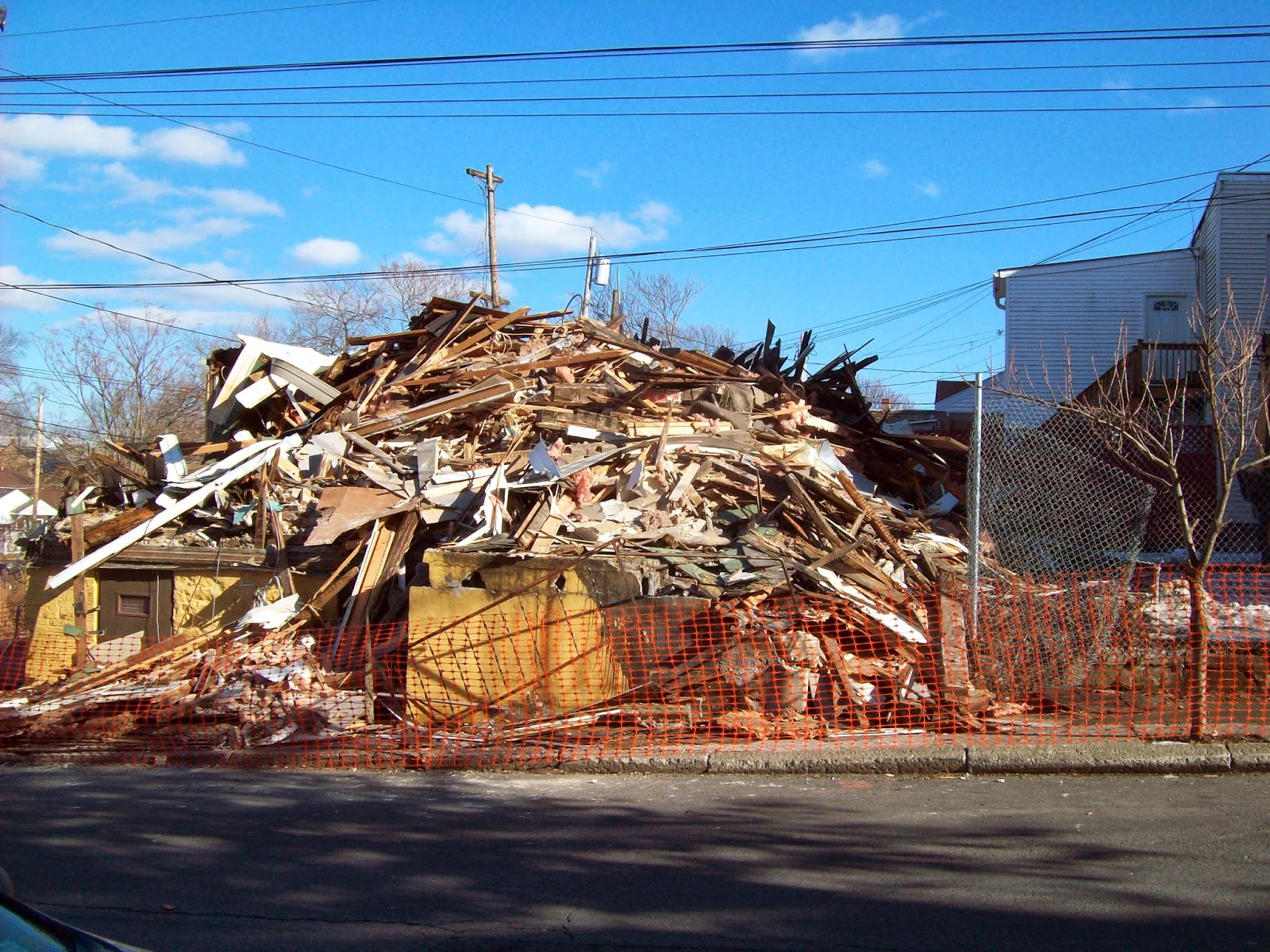
Public safety was, as Gossips understands it, the justification for the "emergency demolition" today of 12 North Second Street. Certainly the site, as it was left this afternoon, surrounded by the impenetrable protection of plastic snow fencing, represents nothing like the threat to public safety that the building posed before the bulldozer/backhoe was unleashed on it.


What is it about an old house that inspires such fear and loathing?
COPYRIGHT 2014 CAROLE OSTERINK

Another Old House Going Down

It's a sad fact that any old house in the Second Ward that survived the devastation of urban renewal in the 1970s is an easy target for demolition today. Today another abused survivor is going down: 12 North Second Street. It is a little known fact, apparently, that this house is/was a contributing structure in the locally designated Warren Street Historic District. No certificate of appropriateness was sought for its demolition.

In 2010, this house was on Bill Hughes' "wish list" of houses that could be demolished to build replacement units for Bliss Towers. Tax records indicate that the house was once part of Phil Gellert's "Northern Empire." In 2003, it was acquired by Galvan Partners, and in 2012, ownership was transferred from Galvan Partners to the not-for-profit Galvan Initiatives Foundation.

According to code enforcement officer Craig Haigh, this was an "emergency demolition," which bypassed the Historic Preservation Commission and was signed off on by Mayor Bill Hallenbeck and city attorney Carl Whitbeck. Presumably the emergency demolition was necessary because the house, which has been owned by Galvan for more than a decade, was falling apart and presented a public safety hazard.
COPYRIGHT 2014 CAROLE OSTERINK

Thursday, March 20, 2014

This Just In: A Schedule Change

If you were planning to spend several hours tomorrow observing the Legal Committee agonizing over possible zoning changes, abandon those plans. The workshop has been postponed for a month, until Friday, April 25, when it will take place at 11 a.m. at the Hoysradt Firehouse.

The Return of the Doors

Gossips has published this picture of the 1936 Columbia County Board of Supervisors a couple of times.

This time, look beyond the men in dark overcoats and fedoras and focus on the courthouse doors.

As Gossips discovered yesterday, the original doors appear to be back.

Whether these are the original doors refurbished or reproductions (probably the latter) is not clear, and one wonders if the garish gold color is temporary or permanent, but they are a stunning improvement over the mid-20th century glass and aluminum abomination that had been there.
COPYRIGHT 2014 CAROLE OSTERINK    

Rejoice!

Today is the first day of Spring, the temperature of above freezing, and the accumulated snow on the ground is almost gone.


Wednesday, March 19, 2014

A Reminder

After a three-week hiatus, the Common Council Legal Committee resumes its examination of the current state of zoning and crafts proposed amendments to the Schedule of Bulk and Area Regulations on Friday, March 21, at 11 a.m. at City Hall. 

Time and Again

Returning to the recently discovered cache of pictures taken almost two decades ago, I found another that provides an opportunity to contemplate the difference that paint makes, specifically paint color. The pictures show 220, 222, 224, and 226 Union Street in 1996 or 1997 and the same four houses today. 


Of the four houses, only 224 seems not to have changed much in twenty years, except to have acquired red roofs on the bay and the little gable over the stoop and a ubiquitous satellite TV dish. The house now has a new owner, and there is renovation work going on inside, so maybe warmer weather will bring changes to the exterior as well.
COPYRIGHT 2014 CAROLE OSTERINK

An Anniversary for Hudson

Two hundred and twenty years ago, on March 19, 1794, at the first meeting of its seventeenth session, the New York State Legislature passed "An ACT for the better extinguishing Fires in the City of Hudson," which enabled the creation of fire companies in Hudson. 

The text of the legislation reads:
I. Be it enacted, by the People of the State of New-York, represented in Senate and Assembly, That it shall and may be lawful for the mayor, recorder, aldermen, and commonalty of the city of Hudson, in common council convened, or major part of them, to nominate and appoint a sufficient number of men (willing to accept) not exceeding twenty, to every fire engine now provided, or hereafter to be provided for the use of said city, out of the inhabitants being freeholders or freemen of the said city, to have the care, management, working, and using the said fire engines, and the other tools and instruments now or hereafter to be provided, for extinguishing fires within the said city; which persons so to be nominated and appointed as aforesaid, shall be called firemen of the city of Hudson, who are hereby required to be ready at all times, as well by night as by day, to manage, work, and use the said fire engines and other tools and instruments aforesaid.
II. And be it further enacted, That each of the persons so to be nominated and appointed a fireman shall, during his continuance in office, be exempted and privileged from serving in the office of constable, and from being impanelled upon any jury or inquest (except in the mayor's court of the said city) and for this purpose the name of each fireman to be appointed by virtue of this act shall be entered with the clerk of the said city, and his certificate shall be sufficient evidence in all courts and elsewhere, of such exemption and privilege; And further, that the said mayor, recorder, aldermen, and commonalty, in common council convened, or the major part of them, shall have power, from time to time, to remove any firemen so to be appointed, and other to appoint in the stead of those removed, when, and as often as they shall think proper; And further, That it shall be lawful for the said mayor, recorder, aldermen, and commonalty, or the major part of them, in common council convened, to make, establish, and ordain such rules and regulations for the government, duty, and behavior of the persons so to be appointed firemen as aforesaid, in the working and frequent using and trying the said fire engines, tools, and instruments, and to impose such reasonable fines and penalties upon such firemen, or any of them, for default in performing the duties thereby to be enjoined or required from them, as they from time to time may think proper.
III. And be it further enacted, That upon the breaking out of any fire within the said city, the marshal and constables then being in the said city, upon notice thereof, shall immediately repair to the place where such fire shall happen, with their staves and other badges of authority, and be aiding and assisting, as well in extinguishing the said fires, as in preventing any goods from being stolen, and also in removing and securing the same; and in the execution of the duties required of them by this act, shall, in all respects, be obedient to the mayor, recorder, and aldermen of the said city, or such of them as shall be present at any such fires.
IV. And be it further enacted, That it shall be lawful for the mayor, recorder, aldermen, and commonalty of the said city, or a major part of them, in common council convened, to direct and require the inhabitants or owners of dwelling-houses and other buildings in the said city, to provide themselves with such and so many fire-buckets, to be ready in such houses and buildings, for the purpose of extinguishing fires, and to impose such reasonable fines and penalties for disobedience thereof as they shall think proper.
A month after the enabling legislation was passed, on April 17, 1794, the Common Council authorized the creation of the first company in Hudson, known today as J. W. Edmonds Hose Company, No. 1. Seven months later, in November 1794, Hudson's second fire company was authorized, H. W. Rogers Hose Company, No. 2. The tradition established two centuries and two decades ago continues. Hudson is one of a very few cities in New York that still has an all-volunteer fire department.

Many thanks to Neal Van Deusen for bringing this important anniversary to Gossips' attention and for providing the image of the pages from Laws of the State of New York on which the act appears

Turn Your Radios On

This morning at 10 a.m., Victor Mendolia interviews Hudson supervisors Sarah Sterling (First Ward) and Bill Hughes (Fourth Ward) on @Issue on WGXC--90.7 F.M. on the radio dial or online at wgxc.org.

A Sad Outcome for Dogs and for Hudson

In the past twenty years, there have been a few nights at City Hall that could take your breath away--not in a good way. Last night was one of them.

Alderman Delaney
When the attention of the Council turned to the local law "Amending Dog Licensing Procedures and Abolishing the Prohibition of Dogs at the Henry Hudson Waterfront Park," Alderman Bart Delaney (Fifth Ward) immediately moved to strike Section 5-3, the part that repealed the ban on dogs in riverfront park. At that point, by some previously worked out orchestration, Alderman John Friedman (Third Ward), chair of the Legal Committee, which had proposed the amendments, presented to his fellow aldermen the petition, which Gossips had delivered to the alderman electronically earlier in the day, when it had 175 signatures, and which, as it was printed in preparation for the meeting, had 191 signatures. (The petition now has 204 signatures, but it doesn't matter anymore.)

Alderman Donahue
Upon receiving the petition, the first words out of the mouth of Alderman "Doc" Donahue (Fifth Ward) were, "Does that mean 191 people will be walking their dogs there?" A bit later in the discussion, Friedman described his experience of walking his dog regularly in riverfront park, attesting to the respectful, law-abiding behavior of other dog walkers. He asked Donahue how often he visited riverfront park, commenting, "I've never seen you there." Donahue countered, "I only go down there when you're not there."

Alderman Garriga
Alderman Tiffany Garriga (Second Ward) made two comments that seem to get to the heart of the problem. She expressed the opinion that there should be a dog park separate from riverfront park, and she observed that "a lot of people who signed the petition have backyards." Her comments suggest that she, and the rest of the aldermen who opposed the repeal, think that the only reason people leave their houses with their dogs in tow is to allow the dogs to relieve themselves. The notion that people walk with their dogs--on the street, in a park, or anywhere--for the simple joy of being outdoors in the company of their best friends, or that they, as a matter of course, take their dogs with them as they go about their daily routines, appears to be completely foreign to Garriga et al,, and the dog owners of Hudson must suffer from their constrained experience and imagination.

Alderman Stewart
It was disappointing when Alderman Ohrine Stewart (Fourth Ward), chair of the Arts, Entertainment & Tourism Committee, asked if the 191 people who signed the petition lived in Hudson. How is that relevant? Are our parks open only to Hudson residents? Does the opinion of people who work in Hudson, own businesses in Hudson, frequently visit Hudson, or in some way have a stake in Hudson's future count for nothing? Alderman Nick Haddad (First Ward) estimated that 75 percent of the signatures on the petition were from Hudson residents, and Gossips' calculations confirm that Haddad was pretty much spot on. 

Needless to say, the effort to repeal the prohibition on dogs in Henry Hudson Riverfront Park failed. The (weighted) vote was 1,373 to 560. Those voting in favor of the repeal were Council president Don Moore and aldermen David Marston (First Ward), Nick Haddad (First Ward), and John Friedman (Third Ward). Those voting against it were, predictably, Garriga, Abdus Miah (Second Ward), Stewart, Delaney, Donahue, and, surprisingly, Henry Haddad (Third Ward).

Alderman Henry Haddad
The younger Haddad maintained that he was representing his constituents' wishes when he voted to continue the ban on dogs in riverfront park. By Gossips' calculations, however, more than 25 percent of the people who signed the petition to repeal the ban--about 50 of 204--live in the Third Ward, and one of them made this comment: "Dogs on leashes, tidied up after, are a wonderful addition to our lives and community. I am in Ward 3, Henry Haddad is my Alderman, and I ask him to please re-consider and make Hudson more welcoming to folks who wish to visit our city with their canine companions. Dogs allowed will enhance our city. Please repeal the prohibition on puppies. Thank you!" Clearly, that appeal fell on deaf ears, if it was ever actually read by Haddad.

Bad decisions are not without consequences. After the vote was taken, Mary Udell, who assists her husband in videotaping the Common Council meetings, called the Council's decision "absolutely insane." She left the room immediately, saying that the Udells were going to stop videotaping Common Council meetings. Dan Udell continued taping the meeting until it was adjourned, but he told Gossips that this was the end. He was disgusted by the majority opinion of the Council and would no longer volunteer his services to document their proceedings.
COPYRIGHT 2014 CAROLE OSTERINK

Tuesday, March 18, 2014

Petition Update

At 1:23 p.m., the petition asking the Common Council to repeal the prohibition on dogs in riverfront park, with 175 signatures, was delivered electronically to Council president Don Moore and all the aldermen, except Robert Donahue (Fifth Ward), who doesn't have an email address.

Tonight, print copies of the petition will be delivered to the Common Council. Between now and about 5 p.m., if you haven't already signed the petition, please do so. The more signatures the better. Click on the banner at the top of the page or click here to access the petition.

Funding the Festivities

Once again, the City of Hudson has budgeted $15,000 to help support events that are created by Hudson-based organizations, take place in Hudson, and have a positive impact on the entire city. And once again, as was done for the first time last year, the Arts, Entertainment & Tourism Committee is asking event planners who would like a piece of the pie to make a formal written application. This year the application is due on May 15. Those interested in applying for funding should contact Council president Don Moore to request the guidelines.

Last year, HDC (Hudson Development Corporation) kicked in another $5,000, making the total pot $20,000. According to Sheena Salvino, executive director of HDC, that may happen again this year. Last year, sixteen events--all but two of those requesting funds--received support from the City. The recipients of the biggest awards were Flag Day and the Hudson Pride Festival, both receiving $3,200.
COPYRIGHT 2014 CAROLE OSTERINK

On Behalf of William

As regular readers know, William is a very old dog. We celebrated his sixteenth birthday last week--an astonishing age for a dog his size. These days we rarely venture farther afield than the end of our own block, but there are still days when William catches the call of something on the wind and, with heartbreakingly valiant determination, tugs me toward the river. Because William can no longer negotiate the steps on the pedestrian bridge, we toil across on the rickety deck of the Ferry Street Bridge, me looking over my shoulder to make sure no car turning off Front Street misses seeing us and worrying that William might get splinters in his paws. When finally we achieve the park, William leads me down the path to the gazebo and along the river, where he likes to sit for a while, enjoying the riot of smells that we humans are mostly oblivious to.

The problem, of course, is that the goal William struggles so mightily to achieve--to be in waterfront park--is illegal. Dogs are not allowed anywhere in Henry Hudson Riverfront Park at any time.

You can help make an old dog happy by signing the petition to ask the Common Council to amend Chapter 70 of the city code and repeal the prohibition on dogs in riverfront park. Please do it now. The Council meets at 7 p.m. tonight. Make it legal for dogs to visit riverfront park in William's lifetime. 
COPYRIGHT 2014 CAROLE OSTERINK

Monday, March 17, 2014

Who Is Buried in Jones' Tomb?

A couple of weeks ago, Gossips shared an article, stumbled upon while searching the pages of the Hudson Daily Register for something else, that reported the remains of Fred W. Jones were missing from his mausoleum. On the trail of what happened, Gossips got distracted by the story of Elizabeth Doyle, the woman who spent five years in the House of Refuge for a crime she didn't commit. But today, Paul Barrett supplied the solution to the Fred W. Jones mystery. According to a news item that appeared in the Register on June 18, 1901, Fred W. Jones's body was "evicted" when the bank foreclosed on his mausoleum.

 MATTER CALLED TO ATTENTION OF DIST. ATTY.
The rumors that have been current about the streets in reference to the alleged body snatching affair in our cemetery were such that the Register noticed them yesterday. It now develops that the remains were removed by order of the Farmer's National Bank. It is claimed by the bank that the mausoleum belongs to the institution, and that the remains were surreptitiously put therein, the lock being broken to do it. Finding that unlawful methods had been used, they had the body removed from their property and notified the Jones estate where the remains now are deposited.
A Register reporter interviewed members of the Jones family to-day. The family have received a letter from the counsel for the bank to-day stating that the casket and body had been removed to another vault, which was the first intimation they had received of its whereabouts. They are indignant, as they claim that the mausoleum is their property, and that the bank or its servants had no more business therein than would body snatchers. Both civil and criminal actions are to be instituted against the bank. The matter has been placed before the District Attorney.
So now we're left with new questions. Where did the bank deposit the remains of Fred W. Jones? And who, if anyone, is buried in Jones' tomb? To quote Paul Barrett on the topic, "You can't make this stuff up."
COPYRIGHT 2014 CAROLE OSTERINK

Another Ear to the Ground

From buttons, to fabric, to extruded plastic, to tea. Sam Pratt reports the rumor that Harney & Sons tea company may use the building at the north end of Second Street for production, storage, and distribution: "Harney Hudson?"

An Appeal on Behalf of the Dogs of Hudson

Tomorrow night, the Common Council will vote on whether or not to amend Chapter 70 of the city code to delete item 70-4.1 (11), which reads: "It shall be unlawful for any owner of a dog in the City of Hudson to permit or allow such dog to . . . be present at any time in Riverfront Park." If it is to have any effect, the petition asking the Council to repeal the prohibition on dogs in the park must be delivered to the aldermen by midday tomorrow. Click here to sign it now. 

The point of amending the law is to acknowledge that leashed dogs are now regularly walked in the park and this practice has not had a disastrous impact on either the park or other visitors to the park. Those who oppose amending Chapter 70 of the city code have argued, somewhat illogically, that there are many dog owners in Hudson who are obeying the law that prohibits dogs in the park but, if that prohibition were lifted, would feel free to bring their dogs to the park and to disobey Hudson's leash and pooper scooper laws and let their dogs run wild in the park and defecate wherever they pleased. Common sense suggests that nothing much would change except responsible dog owners would be able to walk with their dogs in riverfront park without running the risk of being reported and fined between $50 and $150.

If you have a dog, love a dog, know a dog and would like dogs and their people to be able to enjoy riverfront park together legally, please sign the petition now to ask the Common Council to repeal the prohibition.
COPYRIGHT 2014 CAROLE OSTERINK

The picture accompanying this appeal shows William and Turner, who visited here from Michigan with my niece and her family, enjoying the park--illegally, as it turns out--in 2012.

More on the Story of Elizabeth Doyle

Last week, Gossips discovered, in the Hudson Daily Register for June 14, 1901, the story of Elizabeth Doyle, who was convicted and served five years in the House of Refuge at Hudson for stealing a valuable gold ring. More than a year after her accuser confessed, on his deathbed, that he had been mistaken and she was not the one who had stolen the ring, Elizabeth Doyle was released from the House of Refuge. The story as it appeared in the Daily Register raised a number of questions, principal among them: What was the relationship of Elizabeth Doyle and Edmund Doyle, her accuser?

On the same day, and for about a week afterward, the following article, which was probably an Associated Press account, appeared in several newspapers through the state, among them the Monticello Republican Watchman, the Schuylerville Standard, the Silver Springs Signal, the Clyde Democratic Herald, the St. Johnsville Enterprise, the Clinton Courier, and the Mount Vernon Daily Argus.

        
This article provides information that was not included in the report as it appeared in the Register. Elizabeth Doyle was Edmund Doyle's daughter-in-law, and Maggie Allen, the young woman who had actually done the deed, was his granddaughter. Maggie Allen ended up in the House of Refuge at Rochester, presumably for an offense other than stealing Mary O'Brien's valuable gold ring. (This article also gets two of the names wrong: Elizabeth Doyle's mother was named Carrie Jackson not Mary Jackson, and the owner of the ring is identified elsewhere as Julia O'Brien not Mary O'Brien.)

Photo credit: Harvard Art Museums/Fogg Museum, Transfer from the Carpenter Center for the Visual Arts, Social Museum Collection
The day after the story was reported in the Hudson Daily Register, an article appeared in the New York Sun that gives more insight into the sequence of events that led up Elizabeth Doyle's release from the House of Refuge. According to this account, Edmund Doyle's widow kept Maggie Allen's confession to him a secret for two years after his death.


On June 17, 1901, the Rochester Democrat and Chronicle tells a somewhat different tale, attributing Elizabeth Doyle's release from the House of Refuge, after she had almost served her entire five-year sentence, and her exoneration to her mother's unflagging efforts to prove her daughter's innocence. In this article it is revealed that the owner of the ring was Elizabeth Doyle's husband's cousin and the ring had been returned to her four years before Elizabeth Doyle was finally released from the House of Refuge.


Tracy Huling, who has been studying the Record of Prisoners' Visitors at the House of Refuge at the New York State Archive for the Prison Public Memory Project, generously shared this information and the photographs with Gossips. Between January 3, 1899, and June 17, 1901, Mrs. Carrie Jackson, Elizabeth Doyle's mother, visited her daughter eight times. On June 17, the day she was released from the House of Refuge, the log indicates that Elizabeth Doyle had two visitors: her mother (erroneously logged in as "Mrs. Clara Jackson") and Mr. J. P. Barridge, who is identified as a photographer.

The photograph of the House of Refuge reproduced above is dated c. 1900 and is in the collection of the Harvard Art Museums. It was discovered on the Harvard University Open Collections Program website.
COPYRIGHT 2014 CAROLE OSTERINK

Sunday, March 16, 2014

On a Sunday Afternoon

Everyone interested in the future of Hudson--in children and learning and exploration--is invited to Kite's Nest today from 2 to 4 to see what the kids at Kite's Nest have been up to.

Kite's Nest has also published its schedule of spring workshops, which can be reviewed here. There are lots of intriguing things on offer--Gossips' favorites being Woodworking for Girls and Geographies of Stuff.