Tuesday, December 18, 2018

REDC Grants of Interest

The recipients of Regional Economic Development Council grants for 2018 have been announced, and there are a few of interest to us in Hudson.
  • The Ancram Opera House is to receive $30,000 to fund an Artistic Director.
  • Basilica Hudson will receive $58,500 for a project called "Destination Basilica Hudson," which will "host and promote over 35 cultural programs and events to attract new and repeat visitors, from downstate and beyond NYS, to continue to build interest and visibility for Hudson and the Hudson Valley for visitors from near and far."
  • The Bindlestiff Family Cirkus will receive $35,000 to hire a Development Coordinator "to oversee and coordinate the organization's fundraising activities."
  • The City of Hudson will get $263,736 to "upgrade and reconstruct its Power Avenue and Mill Street pump stations to decrease untreated overflows to a Hudson River wetland during storm events."
  • Kite's Nest will receive $100,000 for its North Bay ReGeneration project, which "will transform a former industrial site into a public park and community garden space and a center for educational programs and youth workforce development." This project is also getting $550,000 in DRI funding.
  • South Front Street Holdings LLC is to receive $420,860 for "Red Barn Hudson," a project described as "a year-round farm & flea market, a full-service restaurant and and grab & go cafe, a new destination for the mid-Hudson region." 

All the awards, for projects throughout the state, can be viewed here.
COPYRIGHT 2018 CAROLE OSTERINK

Of Interest

A recent edition of the Bard College newsletter featured an article about Bard Early College Hudson: "Bard Early College Hudson Gives Area Students a Jump-Start on College." The program, which is a collaboration of Bard College, the Hudson City School District, and Questar III BOCES, with support from the Galvan Foundation, is located at 364 Warren Street.
COPYRIGHT 2018 CAROLE OSTERINK

Monday, December 17, 2018

HHA: The Beginning

The recent revelation that the Hudson Housing Authority is planning to double the amount of narrowly defined low-income housing it currently provides rather than create, as originally believed, more diverse mixed income housing has inspired Gossips to try to investigate the beginning of the Hudson Housing Authority. So far, a simple search of old newspapers at FultonHistory.com uncovered these items from the Albany Times-Union, from fifty or so years ago.

The first, which appeared in the Times-Union on July 21, 1966, announces the creation of the Hudson Housing Authority.

HUDSON--A five member housing authority was created Tuesday by Mayor Samuel T. Wheeler, who said, "A milestone has been reached in the history of Hudson."
Members and their terms are: Charles Witham, five years; Edward V. Casserly, four years; Mrs. Susie P. Cunningham, three years, Samuel Liepshutz, two years; and Miss Mary Gorman, one year.
The authority will be headed by Mr. Witham who is an electrical contractor. Mr. Casserly is a vice-president of the State Bank of Albany; Mrs. Cunningham is a teacher at the New York State Training School for Girls; Mr. Liepshutz is a downtown businessman and Miss Gorman is a school psychologist with the city school system.
In addition to appointing the authority, Mayor Wheeler cited the work done in recent years by the Planning Commission. He said, "I wish to thank Arthur Koweek, chairman of the Planning Commission, and the members of the commission for the significant role they played in making this authority possible. Mr. Koweek and the commission members have spent much time and effort in studying the housing problems here and have labored long and diligently in their search for a just and equitable solution to those problems."
More Slums Than Most
The mayor continued:
"Hudson is an old city, with more than its share of old and dilapidated buildings. It also has more than its share of dwellings which are almost unfit in which to live, or which are below the standards of other communities in New York State. The need for better housing, especially for the lower income and retired people in the city has never been fully explored.
With the City of Hudson Housing Authority now a reality, I am confident that concrete and constructive proposals will be made to improve housing conditions, which will, at the same time, eliminate those structures which now represent a threat to the very health and well-being of many of our citizens.
Here I must caution that the new authority will not effect an immediate solution to this long-standing problem. Laws and ordinances will have to be amended and improved. Money will have to be appropriated.
Point with Pride
Mayor Wheeler concluded, "but, with all this, with all the personal inconveniences and disruptions that necessarily must follow in the wake of modern-day changes and progress, the people of Hudson will once again point with pride to their city, the city in which they have chosen to live and to work for the rest of their lives."
The authority will have the power to make applications for the establishment of public housing in the city, make studies, issue bonds for financing, hire employees, etc.
The appointing of the five member authority came on the heels of Governor Rockefeller's signing of the proposal.
The next month, on August 26, 1966, the Times-Union reported that the plan to build "140 housing units for the low income people of Hudson" had been approved by the federal government.


Three years later, at the beginning of 1969, the Hudson Housing Authority began advertising for an executive director.

By late spring 1970, the Housing Authority was soliciting bids for the construction of "135 dwelling units, 15 in low rise frame and brick veneer structure and 120 units in a high rise concrete structure."


And so it began.
COPYRIGHT 2018 CAROLE OSTERINK

Fences Along the Hudson

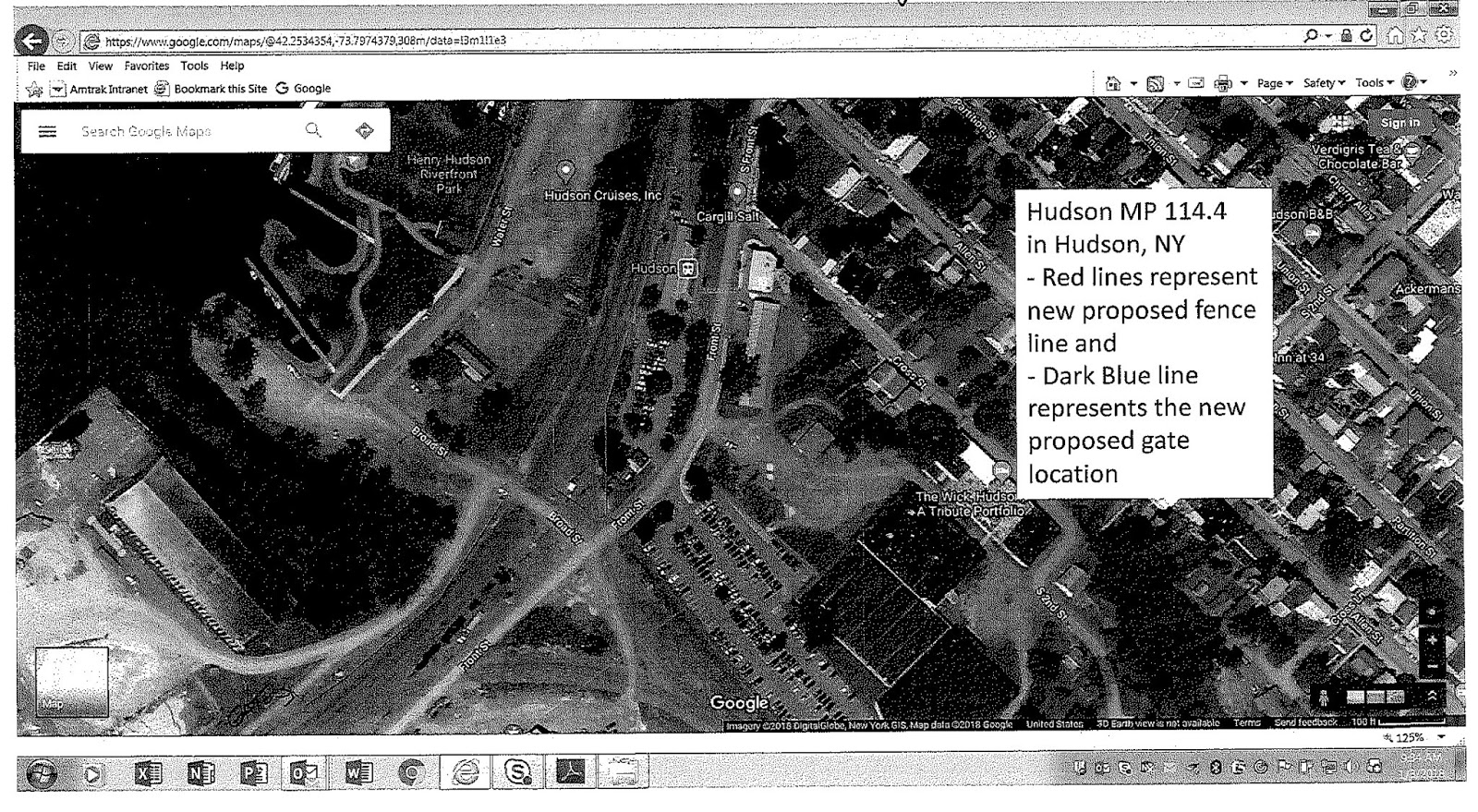
Gossips has been reporting on Amtrak's plans to install fences and gates along the Hudson River--and the opposition to it--since March, when it first came on anyone's radar. At first, it seemed that Hudson was to be spared the eight-foot high black metal fences, but then in May, at a meeting with Amtrak officials organized by Congressman John Faso, Mayor Rick Rector discovered to his horror that there were plans for Hudson, which were part of a proposed Phase 2 of the grand scheme to install fences and gates along the Empire State Corridor from Rhinebeck to Stuyvesant.

About half the fencing in Phase 1 of the proposal would be installed in Germantown, seriously impairing access to the river, and the Germantown Waterfront Committee has taken the lead in opposing the plan. On Saturday, the committee, in collaboration with Scenic Hudson, hosted a forum that explored balancing rail safety with public access. Reports about the forum have already appeared on HudsonValley360 and The Other Hudson Valley, but there are a few additional takeaways from the meeting of particular interest to Gossips readers.

The project must undergo a Coastal Consistency Review by the New York State Department of State. On Saturday, Jeff Anzevino of Scenic Hudson attributed Amtrak's recognition that they were subject to this review to the community opposition here in Hudson to Amtrak's plans to cover our rock face with shotcrete. The plan was discovered in July 2017 by a Gossips reader, and Gossips raised the alarm. The final outcome is less than perfect, but it is better than it might have been, and the attention we in Hudson brought to Amtrak and its activity along the river seem to be having long-term positive impacts.

The State Coastal Policies that are particularly relevant to the proposal to install fences and gates are these:
Policy 19 Protect, maintain, and increase the level and types of access to public water related recreation resources and facilities.
Policy 20 Access to the publicly owned foreshore and to lands immediately adjacent to the foreshore or the water's edge that are publicly owned shall be provided and it shall be provided in a manner compatible with adjoining uses.
Policy 21 Water dependent and water enhanced recreation will be encouraged and facilitated, and will be given priority over non-water related uses along the coast.
Anzevino reminded people on Saturday that it was the State Coastal Policies that defeated St. Lawrence Cement and brought to an end the six-year-long battle against the proposal to build what was to be the world's largest coal-fired cement plant in Greenport. Anzevino also stressed the importance of having a Local Waterfront Revitalization Program in place, which "gives communities leverage in these issues"--something we need to bear in mind here in Hudson. 

As things stand now, Amtrak, in response to a letter from the supervisors of the affected towns in Columbia County, said the plans would be "tweaked." Two public meetings were promised, which, it seems, will be informational meetings not public hearings. As Anzevino told the group gathered in Germantown on Saturday, the immediate goal is: "When this starts back up, we're mobilized." 

To get up to speed on this issue, if you're not already, visit Gatesgate.org.
COPYRIGHT 2018 CAROLE OSTERINK

Meetings of Interest in the Week Ahead

There are not very many meetings in the final week before Christmas, leaving a lot of time for holiday festivities. 
  • On Monday, December 17, the Common Council Fire Committee meets at 5:30 p.m. at the Central Fire Station, 77 North Seventh Street. No agenda is available for this meeting.
  • On Tuesday, December 18, the Common Council Finance Committee meets at 5:30 p.m., and the Common Council holds its regular monthly meeting at 7:00 p.m. No agenda is available as yet for either meeting. Both meetings take place in the Community Room of the Hudson Area Library.
  • On Wednesday, December 19, the Common Council Public Works and Parks Committee meets at 5:15 p.m. at the Central Fire Station, 77 North Seventh Street. This committee has not met since September, so there very likely is a lot to be reported and discussed.
That's it. After Wednesday, all city government meetings have been canceled for the remainder of December. They will resume in the beginning of the new year.
COPYRIGHT 2018 CAROLE OSTERINK

Sunday, December 16, 2018

A Carriage House and a Firehouse

In November, proposed plans for this carriage house in the 300 block of Partition Street were denied a certificate of appropriateness by the Historic Preservation Commission.

On Friday, revised plans for the building fared better. The original plan was to replace the windows and the garage doors. In the revised plan, which the HPC deemed appropriate, the windows are to be repaired and the pattern of the original doors will be replicated in the new doors. The elevation drawings below show the building as it is now and with the proposed changes, which also involve the creation of the roof deck, which the HPC did not find problematic.


At its meeting on Friday, the HPC also saw and heard plans for the restoration of the firehouse on Park Place. This firehouse--actually two firehouses--was the last of the historic firehouses to be sold by the City after the Central Fire Station on North Seventh Street was completed and all but one of the fire companies moved into the new facility. The firehouse on Park Place was purchased from the City at auction by its current owner, Marshall Trachtenberg, in 2008. Ten years later, the plans for the building have finally come together.

What's being proposed is a complete restoration of the facade, including what Trachtenberg called a "grand gesture": re-creating the original arches over the doors. 


The ground floor of the building will become commercial space, and the second floor will be living space for the owner and his family. The rear of the building will see some significant changes, involving the demolition of an existing wooden structure and the construction of a roof tower, a kind of belvedere, to overlook the city and view the Catskills beyond.

The applicant provided a drawing below to illustrate that the tower would not be visible from the street or from Seventh Street Park, a.k.a. the Public Square.

HPC chair Phil Forman commented, "I don't know how much we want to weight the perspective from the alley. . . . This project gets major points for what it's doing at the front, and I'm prepared to tread lightly on the back." Still, Forman suggested and it was agreed that the HPC would "go up there and take a look" at the site and the view of the building from Prison Alley. The site visit will take place prior to the HPC's next meeting, at 9:15 on Friday, January 11.

Trachtenberg told the HPC, "We really believe that this will be a catalyst to bring about a revival of the Public Square," and went on to say that he saw the park as an activity center and wanted to be a part of the park's revival. Craig Haigh, code enforcement officer and former fire chief, pointed out that J. W. Edmonds Hose Company No. 1, organized on April 17, 1794, was the oldest active volunteer fire company in New York State and would be celebrating its 225th anniversary next year. Trachtenberg said they hoped to start work on the building in April 2019, right around the time of the anniversary celebration.

The firehouse, which was built in 1868, was designed by local architect Peter Avery, the same architect who designed Hudson's first city hall at 327 Warren Street, now known as Hudson Hall.
COPYRIGHT 2018 CAROLE OSTERINK

Who Makes These Decisions?

It's been a while since I've ventured outside Hudson, so it was only yesterday, heading to Germantown, that I noticed the Disneyland fusion going on at the new roundabout.

The streetlamps that appear to have been inspired by Main Street at Disneyland have been joined by split rail fences that look like they belong in Frontierland. 
COPYRIGHT 2018 CAROLE OSTERINK

Saturday, December 15, 2018

A Hundred Years Later and Fifty Years Ago

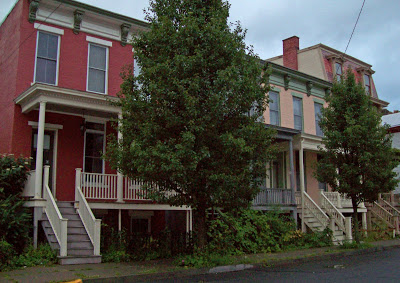
In 2010, Gossips found and published this advertisement, which had appeared in the Hudson Daily Register in February 1867.


The ad established 1867 as the year the construction of this row of houses on North Fifth Street had been completed.

Today, a picture showing these houses in 1967, a hundred years after their construction, was posted to the Facebook group "You're Probably from Hudson" by Bob Satter.

 COPYRIGHT 2018 CAROLE OSTERINK

It Could Be Worse

Property owners in Hudson feel the heavy burden of school taxes, but the Albany Business Review reports that among the 90 school districts in the Capital Region the Hudson City School District ranks 53 when it comes to school taxes (1 being the highest), with the average cost for a $300,000 house being $4,970 and cost per $1,000 of assessed value being $16.57: "The Capital Region's Highest School Taxes."

The highest school taxes are paid in Schenectady (1) and Albany (2).
COPYRIGHT 2018 CAROLE OSTERINK

Friday, December 14, 2018

The Fate of Wildcliff

Two weeks ago, Gossips reported that Wildcliff in New Rochelle, a house designed by premier 19th-century American architect Alexander Jackson Davis and built around 1852, had been destroyed by fire.


Photo: New Rochelle Patch

Earlier this week, it was reported that four thirteen-year-old boys, New Rochelle middle school students, had been arrested--three charged with criminal trespass and the fourth charged with criminal trespass and arson. The story was reported in Talk of the Sound: "WILDCLIFF ARRESTS: Four New Rochelle Middle School Students Arrested for Wildcliff Mansion Fire."
COPYRIGHT 2018 CAROLE OSTERINK

Last Night at the Planning Board

Dan Udell's video of the Hudson Housing Authority presentation to the Planning Board about the proposed new low-income housing buildings is now available on YouTube. Click here to view it.


COPYRIGHT 2018 CAROLE OSTERINK

Thursday, December 13, 2018

HHA Project and the Planning Board

The initial presentation of the Hudson Housing Authority's plan to build more low-income housing across State Street from Bliss Towers before the Planning Board happened tonight. The representatives of the project--among them, two lawyers, two architects, an engineer, a landscape architect, and someone from PRC (Property Resources Corporation) there to explain RAD--filled half the benches in the Council Chamber at City Hall.

Dan Udell was there to videotape the entire proceeding, which took about an hour and a half, so Gossips will focus only on new information disclosed and a few other highlights of the evening.
  • The two buildings proposed for Phase 2 of the plan--the footprint for each is larger than that of Bliss Towers--will each contain 40 units, for a total of 80 more units. (The two buildings in Phase 1 represent 73 new units.) Phase 2 will also involve the expansion of the existing parking lot on Columbia Street, so that it wraps the corner and extends to Bliss Towers along North Second Street--the very area for which volunteers from the Conservation Advisory Council had designed new landscaping.
  • Instead of the economic diversity cited in the Strategic Housing Action Plan and DRI awards --"targeting incomes between 30% and 120% of Area Median Income (AMI)"--only households with incomes between 50 percent and 65 percent of Area Median Income will qualify to be tenants of the "family" building and the "senior" building to be constructed in Phase 1.
Some comments from members of the Planning Board and their legal counsel also merit reporting:
  • Mitch Khosrova, counsel to the Planning Board, advised Charles Gottlieb, one of the attorneys for HHA, to produce the compilation of the comments from the public design charrette and the responses to each--what was feasible, what was best for the project--to head off having it all revisited at the Planning Board's public hearing.
  • Clark Wieman told his colleagues, "We're the Planning Board not the Project Review Board."
  • Speaking of the income levels targeted for the project, Mark Morgan-Perez declared, "That is not diversity in this area at all."
  • Laura Margolis asked, "Was there an assessment done that indicates this is the housing needed here? Are you pursuing this project without knowing the need?"
  • Morgan-Perez suggested that the process might have been "find available funding sources and then build a project around it rather than looking at what the community needs and what it says it needs."
  • Margolis said there were people in Hudson--creative people, people who worked in shops and restaurants--who can't afford the available housing but probably wouldn't qualify for low-income housing. She went on to say, "To develop such a massive project and not look at the people who are living here is disturbing."
  • Walter Chatham, who chairs the Planning Board, said, "We want to serve first the people here and not draw people from out of Hudson."
  • When Wieman commented, "Hudson is now approaching a moment when it is revisiting its comprehensive plan," Chatham observed, "They have adopted a number of New Urbanism strategies" and called the plan "well-intentioned." He also shared what he called his "new favorite axiom": "The perfect is the enemy of the good."
 

Before the meeting ended, Khosrova praised the representatives of PRC for their cooperation and willingness to provide whatever was needed, and Craig Haigh, code enforcement officer, declared, "As of right now, it's only this board," meaning that the proposal conformed with the zoning constraints and requirements and would not have to go before the Zoning Board of Appeals.
COPYRIGHT 2018 CAROLE OSTERINK

South Side, North Side Redux

Three months ago, in September, Gossips marveled at how a development project proposed for the south side of town had been halted by members of the community who thought process was moving too fast and without sufficient community input, while a project on the north side of town was moving ahead apparently without input from the community beyond the residents of Bliss Towers. I spoke too soon. Amanda Purcell reports today on HudsonValley360 that Alderman Tiffany Garriga (Second Ward), former resident of Bliss Towers and long-time critic of the Hudson Housing Authority, is raising questions about the RAD conversion: "Officials raise concern about the future of public housing in Hudson." At last night's Hudson Housing Authority Board of Commissioners meeting, questions were raised about future ownership of the building, the design of the proposed new buildings, and the entire process, which many felt was moving too fast and without sufficient community input.  

Since the public design charrette in October, the design for the two new buildings has changed. No more will they be all brick, meant to be reminiscent of the old Union Mills building, a.k.a. the Pocketbook Factory, at North Sixth and Washington streets.


The revised design involves "a more clapboard type finish for a portion of each building." 


When asked if introducing the "more clapboard type finish"--probably vinyl siding or Hardiplank--had been the result of value engineering, Peter Clements, director of design and construction for PRC, HHA's development partner in the project, acknowledged that the "clapboard like finish" would be less costly than brick but maintained that the change had been made in response to comments at the charrette that the original design for the buildings looked "too monolithic," and the clapboard would make it look "more residential."

Also on display at last night's meeting was a preliminary design for an exterior makeover of Bliss Towers, which involves a combination of brick--"to relate to the buildings across the street"--and some other material yet to be determined.


Clements reported that recent borings disclosed there was "not a lot of integrity to the soil" around Bliss Towers and that "may limit the load of what can be done." HHA commissioner Marie Balle asked, "Since there is a structural integrity issue with Bliss, could it be exacerbated by construction across the street?" Clements dismissed that as not a potential problem.

Some comments at the meeting addressed the design of new buildings. Rebecca Wolff asked about energy considerations--the color of the roof and using geothermal to provide heating and cooling. Matthew Frederick said the ground floor units in the buildings should have their own separate entrances, to make the building feel more like townhouses and create a sense of safety. Most of the comments, however, had to do with the process.

Luisa Burgos-Thillet complained that the residents and the public had been promised they could have continuing input into the planning, but now it seemed the time for input was over. Clark Wieman noted that the ideas from the charrette should be presented and the public should be told how each had been incorporated into the design or why it had been rejected. HHA executive director Tim Mattice said Clements had compiled a list of all the comments from the charrette and seemed to suggest that accounting for how each had been addressed would be part of the Planning Board's review of the project. 

Frederick alleged that the RAD plan was "contrived to send money out of the community," saying that with the proposed co-ownership of the building, "$60 of every $100 in rent leaves the city." Mattice maintained that the developer made its profit only from the development fee. Dan Hubbell, the attorney representing HHA in the RAD conversion and the development project, said the project had gone through a public RFP process, and no Hudson developer had submitted a proposal. He went on to say that RAD was a program, conceived during the Obama administration, to get private money into public housing. He explained that housing authorities could not get a loan from a bank. To do a project without a co-developer would involve bonding. Frederick insisted the public should have seen the possibilities "side by side"--doing RAD or pursuing other financing. 

Wolff asked about other designs or concepts. It was explained that other concepts had been considered and rejected. "You guys did the process," said Wolff, "but we didn't see it." Frederick concurred, "We got the solution, but we didn't see how you got there."

Council president Tom DePietro stated that "nothing in the Strategic Housing Action Plan [adopted by the Common Council in July] said anything about senior housing," and he wanted to know where that came from. "Nothing [in the document] asked for something this big." The following is quoted from the Strategic Housing Action Plan:
Hudson Housing Authority--40 units
The Hudson Housing Authority (HHA) submitted a proposal to construct a mixed-use, mixed income rental housing project on vacant land currently owned by the HHA. This rental housing development is targeting households with incomes ranging from 30% to 120% of the area median income. The project would also include retail and community space on the first floor. The DRI funds will be used for soft costs and construction. . . .
The project was awarded $800,000 in DRI funds. The following is quoted from Capital Region Downtown Revitalization Initiative: Hudson Awards:
Construct Mixed-Use and Mixed-Income Housing on State Street
Develop a vacant parcel of land on State Street for mixed-use and mixed-income housing. The project will include retail and community space on the first floor and approximately 40 units of mixed-income rental housing targeting incomes between 30% and 120% of the Area Median Income (AMI). ($800,000)
What's being proposed now is nearly double that size--33 units in the "senior building" and 40 units in the "family building"--and this is just Phase 1. There is a Phase 2, which involves demolishing the low-rise buildings, a.k.a. Columbia Apartments, and replacing them with three new buildings of unknown size. DePietro alleged that the plan was being driven by the developer, PRC (Property Resources Corporation). Alan Weaver, chair of the HHA Board of Commissioners, and Hubbell responded: "We have to build a project that can be financed."

DePietro also questioned constructing four-story buildings when Hudson code prohibits buildings higher than three stories. Hubbell said the site was in a G-C district and claimed there were "no bulk regulations" in a G-C (General Commercial) district. Gossips raised the issue of zoning and this project back in October, when Mattice claimed there was no zoning in that part of the city. I was in touch with code enforcement officer Craig Haigh yesterday, who said he was in the process of reviewing the project with the attorneys and told me: "It appears the height will be OK. They are preparing to go to the ZBA (Zoning Board of Appeals) as well."

Tonight, the project--both Phase 1 and Phase 2, to avoid segmentation under SEQR (State Environmental Quality Review)--will have its initial presentation to the Planning Board. The Planning Board meets at 6 p.m. at City Hall.
COPYRIGHT 2018 CAROLE OSTERINK

Wednesday, December 12, 2018

Good Fences . . . Yada, Yada, Yada

Gossips has reported on several occasions about the fences and gates Amtrak is planning to erect along the Empire Corridor from Hyde Park to Stuyvesant. The most recent post, published in May, had to do with the plan to install fences and one gate here in Hudson: "What Fresh Hell Is This?"

Amtrak cites safety concerns as justification for the fences that will block access to miles of the Hudson River shoreline, but there is some evidence that such a barrier could actually decrease safety.

On Saturday, December 15, the Town of Rhinebeck and the Town of Germantown will join with Scenic Hudson to explore the question of how both rail safety and river access might be increased. The Forum for Balancing Rail Safety and Public Access, hosted by the Germantown Waterfront Committee, takes place on Saturday at 10 a.m. at the Kellner Activity Building, 54 Palatine Park Road, in Germantown. The announcement of the event describes it in this way:
We will be finding examples from other railroad shorelines around the country and invite you to do the same or think entirely out of the box. There will be panel discussion, a mapping exercise, presentations on pedestrian crossings and "Rail with Trails" and plenty of time for questions, answers, and community discussion.
The Amtrak proposal and more information about the event can be found at Gatesgate.org. Refreshments will be served beginning at 9:30, and people are encouraged to come early to "mix and mingle." Those planning attend are asked to RSVP here. 
COPYRIGHT 2018 CAROLE OSTERINK

Eight Ideas for Oakdale

Last night, Hudson Valley Initiative (HVI) presented its vision for Oakdale Lake, which, as HVI director Kaja Kühl described it, was "a combination of low-hanging fruit and a bigger vision." The vision was based on input from the community, starting in August with a visit to Oakdale and interaction with the children there and continuing with a workshop that took place in October at the Hudson Area Library. To make the larger vision doable, it was divided into eight parts, all of which could be pursued independently.

Idea 1 is the renovation of the beach house and redesign of the entrance. 

The proposed changes to the beach house include a concession bar and rearrangement of the Youth Department office and the bathrooms, to make the latter more accessible. The redesign of the entrance involves closing the entrance on North Sixth Street to vehicles, making it a pedestrian entrance and a drop-off spot for buses and parents bringing their kids to Oakdale. A new entrance from North Seventh Street would be created for vehicles.

Idea 2 is reorganizing all the asphalt covered areas into a multipurpose space for the skate park, basketball courts, and parking and creating a play lawn.

Idea 3 involves enlarging the existing picnic area.

Idea 4 is controlling the algae bloom in the lake. 


Various means of achieving this were suggested, including floating islands that would break down the unwanted nutrients that encourage algae growth.

Idea 5 is a "forest classroom," which would include small installations and interpretive signage along an improved trail through the woods.


Idea 6 is a new playground, with a covered area to provide shelter from rain, bathrooms, and natural installations for play.

Idea 7 is the creation of a picnic grove on the north side of the lake. 

One of the features of the proposed picnic grove is a "Date Nook," which brings to mind--to Gossips' mind at least--the legendary "love rock" on Promenade Hill that Stephen B. Miller, writing in 1862, told about in Historical Sketches of Hudson:
Near the Southern end of the hill, visitors cannot have failed to notice a small circular grove of trees, called "lovers' retreat." These were planted, it is said, to mark the location of a rock known in the early days of the city as "Love rock," and the spot, where "by moon-light alone," a large proportion of the marriage contracts of our Quaker ancestors were "made and entered into."
Idea 8 is a redesign of the western end of the lake, along Glenwood Boulevard.

The plan involves a toddler water play area, a broadwalk, and vegetation to buffer the lake from the street.

There was another idea, in addition to the eight: returning ice skating to Oakdale.

Ice skating on Oakdale Lake, 1968|photobygibson.com
During the discussion the followed the presentation concerns were raised about the multiple uses planned for the hard surface areas. It was asserted that there were times when the basketball court was being used and, simultaneously, parking for seventy cars was required. The opinion was also expressed that one full basketball court and two half courts were not enough.

Matthew Frederick expressed an interest in seeing Underhill Pond included in the plans. He spoke of the potential for creating a chain of green spaces that would connect Oakdale Lake with the Hudson River. 

There were sign-in sheets asking attendees to indicate their interest in one of the eight ideas presented. Tamar Adler, the driving force behind Friends of Oakdale Lake, explained that the proposal had been broken down into eight parts, "so that people can commit to things and start making it happen."

Another meeting, at which the final plans proposed for Oakdale will be presented, is scheduled to take place on Thursday, February 7, in the Community Room of the Hudson Area Library.
COPYRIGHT 2018 CAROLE OSTERINK