There are two items of interest in the news beyond Hudson.
Yesterday, while speaking at Abyssinian Baptist Church in Harlem, Governor Andrew Cuomo announced that he was "ordering the State Police to put together a special unit to address the explosion of hate crimes in our state" following the election of Donald Trump: "The Fight Begins: New York Gov. Cuomo Orders Creation of Special Unit for Hate Crimes."
Yesterday, too, Crain's reported that Republicans in Washington are pushing to eliminate a provision that allows taxpayers to deduct their city and state income tax payments from their federal income tax bills: "Ryan--and Trump's?--tax plan could hurt New Yorkers."
COPYRIGHT 2016 CAROLE OSTERINK

Monday, November 21, 2016

Money Makes the City Go Around
Sunday, November 20, 2016
The Status of Hudson's Lodging Tax
A reader just alerted Gossips that another step has been achieved in the progress of our lodging tax in Albany.
 The legislation was delivered to Governor Andrew Cuomo on November 16. He has ten days from the time it was transmitted to sign it or veto it.
COPYRIGHT 2016 CAROLE OSTERINK
Thanks to Chad Weckler for bringing this to our attention.

COPYRIGHT 2016 CAROLE OSTERINK
Thanks to Chad Weckler for bringing this to our attention.
Winter Walk: Unsilent Night
You don't have to sing or dance, juggle, do magic, or don a costume to be part of the performance at Winter Walk this year. If you have a boom box, an MP3 player, or a smart device that can play an app, you can be part of the infinite orchestra that will move up Warren Street during Hudson's most beloved community event.
 This year, for the first time, Winter Walk will feature Phil Kline's Unsilent Night, described by Time Out as "one of the loveliest communal new-music experiences you'll ever encounter." Everyone is invited to participate in the performance, playing Kline's four-part composition on their own devices--boom boxes, smartphones, MP3 players, whatever else that can be devised--to create "a unique and luminous soundscape." NPR said of the experience, "Over the course of 45 minutes, chiming and chants bounce off walls and windows transforming the coldest urban area with the warmth of musical fellowship." Warren Street during Winter Walk hardly falls into the category of "coldest urban area," so imagine the warmth and spirit that will be created here!
Unsilent Night, which was written specifically to be heard outdoors in the month of December, was first performed in 1992 in Greenwich Village. Since then, it has been performed every December somewhere--from New York to San Francisco, from Brussels to Saskatoon. You can see all the places where it will be performed this December, by clicking here. To learn more about Unsilent Night, you can click here to listen to Ellen Thurston and Tom DePietro talking with Phil Kline last Thursday on WGXC. You can also visit the Unsilent Night website, where you can get more information about how you can participate.
On Saturday, December 3, the night of Winter Walk, Phil Kline himself will be in Hudson to orchestrate the event. In preparation for the performance, he will meet with participants at 4 p.m. at Basilica Hudson. A few vintage boom boxes and audio cassettes will be available, but participants are urged to bring their own devices and to download one of the four tracks in advance. From the Basilica, participants will proceed to Front and Warren streets, where at the stroke of 5, the music will start and the parade up Warren Street will begin, arriving for its crescendo at Seventh Street Park. This promises to be an experience you won't want to miss, but in case you can't be there in person, WGXC will be broadcasting it live at 90.7 FM and online at wgxc.org.
COPYRIGHT 2016 CAROLE OSTERINK

Unsilent Night, which was written specifically to be heard outdoors in the month of December, was first performed in 1992 in Greenwich Village. Since then, it has been performed every December somewhere--from New York to San Francisco, from Brussels to Saskatoon. You can see all the places where it will be performed this December, by clicking here. To learn more about Unsilent Night, you can click here to listen to Ellen Thurston and Tom DePietro talking with Phil Kline last Thursday on WGXC. You can also visit the Unsilent Night website, where you can get more information about how you can participate.
On Saturday, December 3, the night of Winter Walk, Phil Kline himself will be in Hudson to orchestrate the event. In preparation for the performance, he will meet with participants at 4 p.m. at Basilica Hudson. A few vintage boom boxes and audio cassettes will be available, but participants are urged to bring their own devices and to download one of the four tracks in advance. From the Basilica, participants will proceed to Front and Warren streets, where at the stroke of 5, the music will start and the parade up Warren Street will begin, arriving for its crescendo at Seventh Street Park. This promises to be an experience you won't want to miss, but in case you can't be there in person, WGXC will be broadcasting it live at 90.7 FM and online at wgxc.org.
COPYRIGHT 2016 CAROLE OSTERINK
Contemplating Demolition
A proposal to demolish the building at 718-720 Union Street came before the Historic Preservation Commission on Friday.

 The person seeking a certificate of appropriateness to demolish the structure and build in its place a residence and sculpture studio for himself is in contract to purchase the building from Phil Gellert. Gellert had converted the building, which probably started out as some kind of barn or storage facility, into low-income apartments. An article by Jamie Larson, which appeared in the Register-Star in 2011, identified this building as the property belonging to Gellert most often cited for code violations. The following is quoted from that article:
Victor Mendolia, the realtor involved in the sale, asked the HPC to expedite the process because a contract is in place. The applicant told the HPC he did not want to purchase the property if he could not get a certificate of appropriateness to demolish it because he did not want to be "the custodian of a hazard." There are other issues involved. The applicant has no plans for structures he intends to build on the site, and Paragraph 169-8 B of the historic preservation law requires that demolition cannot be approved until the plans for new development have been approved:
COPYRIGHT 2016 CAROLE OSTERINK


718-720 Union St., a converted barn, has received dozens of violations over the years. The building, which only has entrances to the three apartments off the rear alley, was cited numerous times in 2002 because the kitchen sloped to one side due to a severely water damaged support structure. The corner of the building was reportedly found to be held up with jacks.The prospective owner, who wants to demolish the building, told the HPC that there was no evidence that the building was there before 1940 and that the nature of the building didn't justify the effort required to repair and restore it. Code enforcement officer Craig Haigh shared this opinion: "They would have to destroy half the building to achieve code compliance."
Victor Mendolia, the realtor involved in the sale, asked the HPC to expedite the process because a contract is in place. The applicant told the HPC he did not want to purchase the property if he could not get a certificate of appropriateness to demolish it because he did not want to be "the custodian of a hazard." There are other issues involved. The applicant has no plans for structures he intends to build on the site, and Paragraph 169-8 B of the historic preservation law requires that demolition cannot be approved until the plans for new development have been approved:
Demolition shall be permitted only after the owner of the site has submitted and obtained design approval of his/her plans for new development under the provisions of this chapter, including an acceptable timetable and guarantees, which may include performance bonds for demolition and completion of the project. In no case shall the time between demolition and commencement of new construction or lot improvement exceed six months.The Historic Preservation Commission unanimously agreed to hold a public hearing on the request for demolition. The public hearing will take place on Friday, December 9, at 10 a.m., in City Hall.
COPYRIGHT 2016 CAROLE OSTERINK
Saturday, November 19, 2016
Is It, or Isn't It?
Since August, when the Common Council Economic Development Committee began discussing a request for proposals (RFP) to develop the Dunn building on the waterfront, there has been a question of whether or not the Dunn building was included in the Hudson Historic District listed in the National Register of Historic Places. National Register designation is required to qualify for preservation tax credits, an important incentive for rehabilitating historic structures.
 Some thought it was, based on the fact that it was included in the building inventory done by Shirley Dunn in 1984, which was the basis for the Hudson Historic District nomination in 1985. The building was nominated not only as a contributing structure in the historic district but also for individual designation. But, although the building was determined to be eligible for listing in the National Register, it never actually was. A letter, dated November 16, 2016, to Mayor Tiffany Martin Hamilton from Weston Davey at the State Historic Preservation Office explains why: "Documentation for the Hudson MRA (Multiple Resource Area) was completed in 1985, but the Hudson and Boston Railroad Shop [what we now know as the Dunn building] was not listed at that time due to property owner objections." The owner at the time was the Stockport Lumber Company.
Since the building has already been deemed eligible, the City can move forward, thirty years later, on getting the building listed in the National Register of Historic Places, thus assuring that preservation tax credits will be available to the developer who wants to take on the building's rehabilitation and reuse.
Meanwhile, the 1985 survey of this building contains some very interesting and important information. The building is identified in the document as the "Hudson and Boston Railroad Shop." The original date of construction is given as c. 1850, and it is noted that the clerestory was added in the 20th century, probably early in the 20th century. In the 20th century, too, but probably later, the overhead door in the south elevation was added, and the arched openings in the west elevation were bricked up. In 1985, the building's condition was listed was "good," and the threat to the building was identified as "developers."
Of particular interest, especially to those of us who have been perpetuating the misconception that the building had some connection with the Hudson Gasification Works, is Dunn's account of the Interrelationship of Building and Surroundings and the Historical and Architectural Importance of the building. The following are quotes from the 1985 nominating document:

 COPYRIGHT 2016 CAROLE OSTERINK

Since the building has already been deemed eligible, the City can move forward, thirty years later, on getting the building listed in the National Register of Historic Places, thus assuring that preservation tax credits will be available to the developer who wants to take on the building's rehabilitation and reuse.
Meanwhile, the 1985 survey of this building contains some very interesting and important information. The building is identified in the document as the "Hudson and Boston Railroad Shop." The original date of construction is given as c. 1850, and it is noted that the clerestory was added in the 20th century, probably early in the 20th century. In the 20th century, too, but probably later, the overhead door in the south elevation was added, and the arched openings in the west elevation were bricked up. In 1985, the building's condition was listed was "good," and the threat to the building was identified as "developers."
Of particular interest, especially to those of us who have been perpetuating the misconception that the building had some connection with the Hudson Gasification Works, is Dunn's account of the Interrelationship of Building and Surroundings and the Historical and Architectural Importance of the building. The following are quotes from the 1985 nominating document:
The building was heightened since 1881, when a rectangular one story structure with three arched openings similar to those remaining on the first floor of the present building was depicted on a "bird's-eye" view of the city. Earlier, a rectangular building is shown located on this same corner as early as a map of 1851. On that map the words "Engine [Sh]op" are printed over the building; later maps identify it as belonging to the Hudson and Boston Railroad. Early brick bond on the lower parts of the present building, as well as the openings, suggest that the present building is the one shown in 1851. During the 1850's, a polygonal gas-holder house was erected northeast of the Hudson and Boston Railroad Shop. Other industrial buildings were erected nearby in Hudson's major district for heavy industry such as an iron furnace and a railroad car wheel factory. All were located on fill in the former South Bay. All the nineteenth-century industrial buildings except the Hudson and Boston Railroad Shop are now gone. . . .
The Hudson and Boston Railroad Shop is a unique survivor in a former area of heavy industry associated with the City of Hudson, and embodies the characteristics of a mid-nineteenth century industrial building. Its ventilator roofs, multiple bays for machinery repair, and brick construction illustrate a railroad structure associated with the later busiest and most prosperous years of the city.
The Hudson and Berkshire (later Boston) Railroad had been contemplated as early as 1826, as a means of connecting western Massachusetts with the Hudson River. After a survey of the route proposed was made in 1827 and 1828, public interest and support increased; disputes over proposed routes and the opposition of Massachusetts politicians were finally overcome in 1835, when charters were issued in both states. Stock subscriptions were quickly taken from an enthusiastic public and the road was begun in 1837. Marble from quarries in western Massachusetts to be shipped via the Hudson river, and passengers going east to hot springs at the New York-Massachusetts border were two industries that were expected to advance the prosperity of the line, but the railroad, opened in 1838, suffered from primitive equipment, such as iron-topped wooden rails which prevented heavy trains from using the track. The equipment was improved and the road extended east to Boston, Massachusetts, but under the weight of debt, including New York State bonds, the road was foreclosed in 1854.
Reorganized under the management of the Boston and Albany Railroad which had been laid along the river in 1850, the Hudson and Boston successfully operated after that time. Both railroads contributed to the flowering of heavy industry in Hudson, an era that peaked after the Civil War.
By 1858, the shops of both railroads, as well as their passenger and freight stations, contributed to the concentration of brick buildings lying on Hudson's former south bay. However, of all the dozen or more structures representing this industrial concentration, only the Hudson and Boston Railroad Shop and the Hudson Railroad station remain.The 1985 inventory was accompanied by these two photographs of the building.


Friday, November 18, 2016
One Good Thing Ends, Another Begins

After taking Thanksgiving weekend off, many of your favorite HFM vendors will return on Saturday, December 3, for the opening of the Hudson Indoor Market. The indoor market will happen every Saturday in December, right up to Christmas Eve. This year, the indoor market will be in a new, more spacious location: Hudson Lodge at 601 Union Street.

Photos courtesy Christine Jones
A Tempest in a Teapot
The Register-Star today published an article meant to dismiss the rumor that the Turkey Trot, a road race that has taken place on Thanksgiving morning for at least the past twenty-three years, would not happen this year: "Turkey Trot, traditional Thanksgiving event, is a go, officials say." As it turns out, it was a Facebook post by former mayor William Hallenbeck that incited the firestorm of outraged comments on Facebook and notorious Voy chat board. A few hours ago, Mayor Tiffany Martin Hamilton used Facebook to respond to the article and the allegations from Hallenbeck quoted in the article. Here's what she had to say:
COPYRIGHT 2016 CAROLE OSTERINK
In recent days, there has been a tremendous amount of misinformation circulated that I would like to dispel.
In years past, members of the Elks club held elected and/or appointed positions in the Mayor's office, the Youth Department, and other City departments. Various Elks community events--Flag Day in particular--were coordinated through the Mayor's office. In an effort to treat all community organizations fairly and avoid having to put City business aside, this practice was discontinued when I took office. No events are coordinated by my office--this includes Flag Day, Winter Walk, the Pride Parade, etc.
In today's Register Star article regarding the Turkey Trot, Bill Hallenbeck makes some very disconcerting statements:
"It's always been a common practice for the city to participate in the Turkey Trot, as with the Flag Day Parade. Since the mayor took over, the city said they would not participate with the Elks in the Flag Day Parade. Then, it was asked of me why the Youth Department decided not to spend any money on ribbons for Hoop Shoot this year, which took place about a month ago. . . .Over 20 to 25 years, we've never had any glitches, or a Youth Department who has said no to the Elks Department as many times as they have. I know these people donate to a lot of areas, so it didn't seem right to me, the domino effect of not buying the ribbons, then the Flag Day Parade, now this."
Mr. Hallenbeck's statements were not only incorrect; the City never said it wouldn't participate in the Turkey Trot, but he discounts the many hours worked by City of Hudson employees and volunteers, many of whom are proud members of the Elks. That is unacceptable. The Hudson Police Department, Department of Public Works, and the Hudson Fire Department all contribute countless hours and resources to the Elks' largest annual event, Flag Day. DPW allocates a minimum of two days' worth of man hours in the week leading up to Flag Day. Additionally, there is 5K in DPW overtime for the event itself and the subsequent clean-up, plus $5K in HPD overtime to manage traffic flow and maintain public safety the day of the event. In past years, as well as this year, the Elks have received awards from the Common Council Arts, Entertainment and Tourism Committee to help fund the event; this year's award was $3K. I have attended every event that the Elks' leadership has graciously invited me to attend or participate in, including Flag Day. I am very proud of our dedicated City workforce and volunteers and the job they do supporting all local events here in Hudson.
Mr. Hallenbeck's comments are not based on fact but rather on his personal feelings, perhaps stemming from his defeat in the last election, and do little to help the new administrations of the Elks Club and the City to work together in harmony. In speaking with many individual members of the Hudson Elks Lodge, I have learned his opinion is not shared by the organization at large. I have reached out to the Elks Exalted Ruler, Christine Grossman, and I look forward to having the opportunity to meet with her.Now, what was it that Common Council president Claudia DeStefano said about Facebook being "a blessing and a curse"?
COPYRIGHT 2016 CAROLE OSTERINK
Thursday, November 17, 2016
In Memoriam
Gossips has learned that Ruth Moser died this morning.

For as long as I've lived in Hudson, Ruth was my neighbor, her house being a block downstreet from mine. My introduction to Ruth was seeing her walking a pair of greyhounds around town in the early evening. She was devoted to rescuing racing dogs and giving them a wonderful and loving home where they could live out their lives. The greyhound with Ruth in the picture above is Boy Boy, the last greyhound in her life. Boy Boy once escaped from Ruth's backyard and led everyone, including the Hudson Police Department, on a merry chase. According to the officer who finally managed to capture Boy Boy, "A greyhound running full-out is something amazing to behold." After Boy Boy passed away, Ruth transitioned to whippets, the most recent of which was Cedric.
One of my favorite memories of Ruth is associated with the death of George Duguay. George was "the genius of Hudson," a memorable Hudson character, who had lived in our neighborhood--the southwest corner of Hudson--for his entire life, a life that began in 1911. George's favorite flowers were peonies, which he pronounced "pineys." For his memorial service, in the dead of winter 2006, Ruth generously and miraculously provided a glorious bouquet of pineys.
For those of us who take solace in the myth of Rainbow Bridge, we can imagine Ruth, reunited with her beloved greyhounds and whippets, who have been waiting there for her, crossing Rainbow Bridge in their exuberant company.
COPYRIGHT 2016 CAROLE OSTERINK

For as long as I've lived in Hudson, Ruth was my neighbor, her house being a block downstreet from mine. My introduction to Ruth was seeing her walking a pair of greyhounds around town in the early evening. She was devoted to rescuing racing dogs and giving them a wonderful and loving home where they could live out their lives. The greyhound with Ruth in the picture above is Boy Boy, the last greyhound in her life. Boy Boy once escaped from Ruth's backyard and led everyone, including the Hudson Police Department, on a merry chase. According to the officer who finally managed to capture Boy Boy, "A greyhound running full-out is something amazing to behold." After Boy Boy passed away, Ruth transitioned to whippets, the most recent of which was Cedric.
One of my favorite memories of Ruth is associated with the death of George Duguay. George was "the genius of Hudson," a memorable Hudson character, who had lived in our neighborhood--the southwest corner of Hudson--for his entire life, a life that began in 1911. George's favorite flowers were peonies, which he pronounced "pineys." For his memorial service, in the dead of winter 2006, Ruth generously and miraculously provided a glorious bouquet of pineys.
For those of us who take solace in the myth of Rainbow Bridge, we can imagine Ruth, reunited with her beloved greyhounds and whippets, who have been waiting there for her, crossing Rainbow Bridge in their exuberant company.
COPYRIGHT 2016 CAROLE OSTERINK
Wednesday, November 16, 2016
One Parcel, Two Needs
Last Thursday, a plan to build a new headquarters for Greater Hudson Promise Neighborhood was presented to the Planning Board. The plan involves three lots on the 200 block of Columbia Street: 209, 211, and 213. It was acknowledged that Promise Neighborhood does not currently own the lots on which they propose building. Indeed, it seems that Promise Neighborhood is not yet in contract to purchase any of these parcels.
 At the same Planning Board meeting, the proposal to convert 214-216 Warren Street, now the location of the Savoia, into a nine-room hotel was presented. The stumbling block, as it is with so many projects that come before the Planning Board, was parking. The plan includes only three parking spaces behind the building, one of which would be a handicapped parking space. The code requires nine off-street parking spaces, one for each room in the hotel. Before the public hearing on the hotel project, which is scheduled for December 8, the applicant was asked to submit a plan to provide the additional six parking spaces.
Now, 214-216 Warren Street, the once and future Howard Hotel, is virtually right across Prison Alley from 209-211 Columbia Street.
 It would seem logical for the new owners of 214-216 Warren Street to solve their parking problem by simply buying 209-211 Columbia Street--it's still on the market--to create a parking lot for the hotel there. Of course, by doing so, they probably risk bringing down on their heads the same righteous outrage that was visited on the Galvan Foundation last summer when they quadrupled the rent on Promise Neighborhood's current location on South Second Street. But maybe some agreement could be reached.
 Promise Neighbor's plans include eight parking spaces along Prison Alley. One of the reasons they want this location is because it is close to where the population served by Promise Neighborhood lives. That doesn't suggest that many people visiting the site will arrive by car. Nor is it likely that Promise Neighborhood will require a lot of space for overnight parking. Might there be a chance for the developers of the Howard Hotel and Promise Neighborhood to work out some kind of deal to share parking space?
Hudson is only two square miles, and there's a lot going on here now, and more that wants to happen. We need to find ways to share our limited land mass.
COPYRIGHT 2016 CAROLE OSTERINK

Now, 214-216 Warren Street, the once and future Howard Hotel, is virtually right across Prison Alley from 209-211 Columbia Street.


Hudson is only two square miles, and there's a lot going on here now, and more that wants to happen. We need to find ways to share our limited land mass.
COPYRIGHT 2016 CAROLE OSTERINK
For Your Viewing Pleasure
Dan Udell's video of the very uneventful mayor's hearing on the 2017 budget and the comparatively tame November Common Council meeting, both of which took place at City Hall last night, can now be viewed by clicking here.
 COPYRIGHT 2016 CAROLE OSTERINK
The Future for Hudson Avenue
Last night, the Common Council voted to amend the zoning for three parcels of land on the west side of Hudson Avenue, changing it from I-1 (Industrial) to R-S-C (Residential Special Commercial).
 Common Council president Claudia DeStefano voted against the zoning amendment, saying she was concerned about "the unknown of the 'S-C' part of the zoning." Alderman Robert "Doc" Donahue likewise voted no, saying that he thought the zoning change should be to R-3, like the adjacent area, rather than R-S-C. The rest of the members of the Council voted to approve the zoning amendment. The final vote was 1,474 aye, 554 nay.
 The change in the zoning was needed to enable the owner of the parcels, architect Walter Chatham, to build a block of four row houses on the property. Residential is the only use not permitted in areas zoned I-1.
COPYRIGHT 2016 CAROLE OSTERINK


COPYRIGHT 2016 CAROLE OSTERINK
Tuesday, November 15, 2016
Celestial Occurrences


The writer speculates, in 1889, that human endeavor may have an impact on natural events--in this case, causing the aurora borealis to become a rarely seen phenomenon.
COPYRIGHT 2016 CAROLE OSTERINK
Monday, November 14, 2016
What Our Governor Has Done Recently
On Friday, Governor Andrew Cuomo signed legislation that will extend the state film production tax credit to twelve additional counties, most notably Columbia County and other counties in the Hudson Valley. We can look forward to more movies being filmed in and around our beautiful little city.
On Sunday, Governor Cuomo offered New York as a refuge for those fleeing a Trump presidency.
COPYRIGHT 2016 CAROLE OSTERINK
On Sunday, Governor Cuomo offered New York as a refuge for those fleeing a Trump presidency.
As New Yorkers, we have fundamentally different philosophies than what Donald Trump laid out in his campaign. So let me be absolutely clear: If anyone feels that they are under attack, I want them to know that the state of New York--the state that has the Statue of Liberty in its harbor--is their refuge.Excelsior!
COPYRIGHT 2016 CAROLE OSTERINK
Sunday, November 13, 2016
Pursuing an 1889 Arson Case
A couple of weeks ago, Gossips published a report, from the Hudson Daily Evening Register for November 8, 1889, on the arrest of an arsonist, an eighteen-year-old named Willam Casey, Jr. The story was interesting because the fire had been set in a building in Cherry Alley that belonged to Henry S. Moul, who had not yet begun his prolific career as an architect in Hudson, and because authorities had been led to the culprit by newspapers found at the scene.
As it turns out, the interest of the story doesn't end there. The next day, November 9, 1889, the Evening Register reported, with considerable indignation, that, despite twenty witnesses providing evidence against him and the accused's own confession, "respectability" was offered as a "palliation of crime," and the jury recommended clemency for William Casey, Jr. Indeed, it seems the jury was willing to accept that Casey's motive for starting the fire was not to cause destruction but to give himself an opportunity to show what a good fireman he would be.

The Evening Register, however, was having none of it and railed at length against the jury's verdict.
COPYRIGHT 2016 CAROLE OSTERINK
As it turns out, the interest of the story doesn't end there. The next day, November 9, 1889, the Evening Register reported, with considerable indignation, that, despite twenty witnesses providing evidence against him and the accused's own confession, "respectability" was offered as a "palliation of crime," and the jury recommended clemency for William Casey, Jr. Indeed, it seems the jury was willing to accept that Casey's motive for starting the fire was not to cause destruction but to give himself an opportunity to show what a good fireman he would be.

 |
| Photo courtesy Historic Hudson |
That is about the thinnest coat of white wash that was ever attempted to be applied to a self-confessed criminal, and every man who appended his signature to it ought to be ashamed of the act. The citizens of Hudson are in no temper to indorse [sic] such a verdict and recommendation to "clemency" in so aggravated a case.
The frequency of fires in Alley barns and sheds during the past few years prompted the city authorities to offer a liberal reward for the apprehension of incendiaries. Not long ago one of these juvenile fire bugs was apprehended and convicted. Through some unknown influence he was let off with light punishment. The Register at the time admonished the authorities that this sort of "clemency" must not be repeated. And now, when another clear case is presented and the evident ringleader of the gang is within the grasp of the law, a jury of intelligent citizens, summoned by a Coroner, recommend the criminal to "clemency" because of his "respectability" and ambition "to become a fireman." Let us hear no more of "Dogberry opinions." *
These Alley fires are the most dangerous and dastardly crimes the city has to cope with. They have caused more annoyance and loss of property within a few years than all other causes combined. There is no amount of "respectability" that can shield the perpetrators of those cowardly and criminal acts. The fact that the accused is of highly respectable family, well educated, and surrounded by moral and elevating influences, adds to the heinousness of the offence. Had he come from the "slums," surrounded by depraved influences, ignorance and lack of moral culture might be pleaded in extenuation. But in this case there is not a redeeming feature or a palliating circumstance.
It is hardly creditable to assume that this was his first offence, or that he had no accomplices. The gang of juvenile incendiaries that infest this city must be broken up, at whatever cost. When one is captured, of which we have an instance before us, he should be punished. He should be made an example of, and that example should be so conspicuous that he will have no imitators, and the apprehension of the balance of the gang will be likely to speedily follow.
This remarkable verdict, moreover, contains an impiled [sic] insult to our firemen. Incendiarism is not a passport to membership in our fire department, which justly prides itself on the honor, integrity, vigilance and effective service of its members, and every true fireman in the city spurns this imputation upon their fair name.
Let the law take its course. If young Casey is guilty of the crime charged, he should be made to suffer the extreme penalty provided in such cases, and his associates in crime should speedily follow him. We may be harsh, but in such action lays the only safety of the community. The city cannot afford to foster these juvenile criminals, and the sooner it is rid of them the better it will be for the people and the offenders. Justice is not compatible with "clemency" is such cases.* Dogberry is the constable of the Watch, a comic character, in Shakespeare's As You Like It. Used in this way, as an adjective, "Dogberry opinions," the writer probably intended it to mean "foolish, or incompetent."
COPYRIGHT 2016 CAROLE OSTERINK
Saturday, November 12, 2016
Not to Be Missed This Afternoon
Two toll houses still stand on either end of Route 23--both listed in the National Register of Historic Places. Known as East Gate (Hillsdale) and West Gate (Greenport), they marked the beginning and end of Columbia County's first turnpike, established in 1799 by the New York State Assembly.


This afternoon, Peter Cipkowski will present a lecture entitled "All Roads to the River: The 1799 Columbia Turnpike and Historic Toll Houses." In his lecture, Cipkowski will explore the Columbia Turnpike and its part in demonstrating the Hudson River's importance as an artery of inland commerce and its place in Columbia County's history. Several historic districts, historic places, and landmark buildings line the route from the Massachusetts border to the Hudson River, and Cipkowski will also describe efforts underway to preserve the existing toll houses and to designate Route 23 as a scenic byway with historic importance.
The lecture, which is sponsored by Historic Hudson and the Columbia County Historical Society, begins at 4 p.m. at the Kinderhook Village Hall, 6 Chatham Street, in Kinderhook. Advance tickets can be purchased online at the website of Historic Hudson or the Columbia County Historical Society. Tickets may also be purchased at the door.
COPYRIGHT 2016 CAROLE OSTERINK


This afternoon, Peter Cipkowski will present a lecture entitled "All Roads to the River: The 1799 Columbia Turnpike and Historic Toll Houses." In his lecture, Cipkowski will explore the Columbia Turnpike and its part in demonstrating the Hudson River's importance as an artery of inland commerce and its place in Columbia County's history. Several historic districts, historic places, and landmark buildings line the route from the Massachusetts border to the Hudson River, and Cipkowski will also describe efforts underway to preserve the existing toll houses and to designate Route 23 as a scenic byway with historic importance.
The lecture, which is sponsored by Historic Hudson and the Columbia County Historical Society, begins at 4 p.m. at the Kinderhook Village Hall, 6 Chatham Street, in Kinderhook. Advance tickets can be purchased online at the website of Historic Hudson or the Columbia County Historical Society. Tickets may also be purchased at the door.
COPYRIGHT 2016 CAROLE OSTERINK
Breaking News from the Register-Star

COPYRIGHT 2016 CAROLE OSTERINK
Friday, November 11, 2016
More News from the Planning Board Meeting

The Planning Board also unanimously approved the plan for an outdoor venue at Rivertown Lodge, 731 Warren Street.
Another item not on the published agenda was a new proposal to open a cafe, catering mostly to takeout business, and a space for games at 750 Columbia, presumably next to the laundromat and two doors away from our local Subway. The applicant explained that she wanted to target the "under 18 crowd" as well as hospital workers "at shift change." The Planning Board intends to hold a public hearing on the proposal at its next meeting on December 8, provided that the applicant submits a seating plan, indicating the maximum number of seats in the cafe, ten days prior to that date.


The Planning Board will hold a public hearing on this proposal at its next meeting on December 8.
The final project presented to the Planning Board on Thursday was the next iteration of 214-216 Warren Street, now the Savoia. The plan is to bring the building back to an earlier use and even resurrect an earlier name: Howard Hotel.


The part of the building behind and above what is now the Savoia will be transformed into a nine-room hotel and event space. The eastern half of what is now the Savoia (the ground floor of 216 Warren Street) will become the lobby of the hotel, and western half will continue to be a bar and lounge, primarily for hotel guests.
 |
| Kristina Dousharm Architecture + FDesign.co |
COPYRIGHT 2016 CAROLE OSTERINK
On Veterans Day
On the ninety-eighth anniversary of the end of World War I, the war to end all wars, Gossips salutes, with gratitude, all our veterans.
 COPYRIGHT 2016 CAROLE OSTERINK

The State of the Haul Road
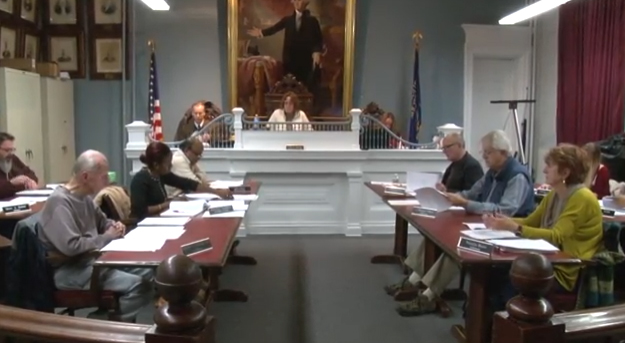
Last night, at the Planning Board meeting, the board got an update on the status of the permitting process for the proposed Colarusso haul road, from Colarusso's headquarters on Newman Road to the Hudson waterfront.
 The discussion began with Planning Board chair Tom DePietro announcing that the Department of Environmental Conservation (DEC) had designated the Greenport Planning Board the lead agency in the State Environmental Quality Review (SEQR) "because more of the project is in Greenport." This means that Greenport will be deciding whether to make a negative or positive declaration about the environmental impacts of the project. In addition to participating in the coordinated review with Greenport, the Hudson Planning Board must also review the project for consistency with the City's LWRP (Local Waterfront Revitalization Program).
Pat Prendergast, the engineer employed now by Colarusso and formerly by O&G/Holcim, began his presentation by reminding the board that the "whole purpose" of the haul road is to "shorten the route and keep trucks out of Greenport and off the city truck route." He reported that a revised storm water pollution prevention plan had been submitted to the DEC and that the Office of Parks, Recreation and Historic Preservation had reviewed the plan and determined that no archaeological or historic resources would be negatively impacted.
Prendergast reported that the Department of Transportation (DOT) had requested changes to the course of the haul road as it approaches Route 9G. DOT wants the haul road to be perpendicular to the state highway and curbing installed to discourage trucks exiting the haul road from turning north into Hudson. DOT also requested signage: "No Left Turn" on the west side of 9G; "No Right Turn" on the east side of 9G.
Ray Jurkowski, the engineer from Morris Associates retained to advise the Planning Board on this project, asked Prendergast, not for the first time, how many trucks trips through Hudson would be eliminated by the haul road. He also noted that the permitting process for this project has been going on for several years, through different applicants and owners of the property, and requested, on behalf of the Planning Board, a chronology of the process—what applications had been submitted, what permits had been obtained—as well as copies of all the correspondence between the applicants and the state regulatory agencies. He urged the members of the Planning Board to review the plans submitted (not long before the meeting) "as quickly as possible" to identify "Hudson concerns." These, he advised, should be outlined in a letter to the Greenport Planning Board "to put them on notice that Hudson has concerns."
At the end of the discussion, audience member Timothy O'Connor objected that the EAF (Environmental Assessment Form) that had been completed for this project was incorrect, and that the municipal boundaries on the map accompanying the site plan for the project were incorrect. Reacting to the second objection, Prendergast asked, "Are you a surveyor?" Judging by a comment made on Gossips, it wouldn't take a surveyor to recognize the error. The map allegedly puts the Dr. Oliver Bronson House and grounds not in Hudson but in the Town of Greenport.
The next Greenport Planning Board meeting takes place on Tuesday, November 22, at 7:30 p.m., at Greenport Town Hall. The Colarusso haul road is the second item on the agenda for that meeting.
COPYRIGHT 2016 CAROLE OSTERINK

Pat Prendergast, the engineer employed now by Colarusso and formerly by O&G/Holcim, began his presentation by reminding the board that the "whole purpose" of the haul road is to "shorten the route and keep trucks out of Greenport and off the city truck route." He reported that a revised storm water pollution prevention plan had been submitted to the DEC and that the Office of Parks, Recreation and Historic Preservation had reviewed the plan and determined that no archaeological or historic resources would be negatively impacted.
Prendergast reported that the Department of Transportation (DOT) had requested changes to the course of the haul road as it approaches Route 9G. DOT wants the haul road to be perpendicular to the state highway and curbing installed to discourage trucks exiting the haul road from turning north into Hudson. DOT also requested signage: "No Left Turn" on the west side of 9G; "No Right Turn" on the east side of 9G.
Ray Jurkowski, the engineer from Morris Associates retained to advise the Planning Board on this project, asked Prendergast, not for the first time, how many trucks trips through Hudson would be eliminated by the haul road. He also noted that the permitting process for this project has been going on for several years, through different applicants and owners of the property, and requested, on behalf of the Planning Board, a chronology of the process—what applications had been submitted, what permits had been obtained—as well as copies of all the correspondence between the applicants and the state regulatory agencies. He urged the members of the Planning Board to review the plans submitted (not long before the meeting) "as quickly as possible" to identify "Hudson concerns." These, he advised, should be outlined in a letter to the Greenport Planning Board "to put them on notice that Hudson has concerns."
At the end of the discussion, audience member Timothy O'Connor objected that the EAF (Environmental Assessment Form) that had been completed for this project was incorrect, and that the municipal boundaries on the map accompanying the site plan for the project were incorrect. Reacting to the second objection, Prendergast asked, "Are you a surveyor?" Judging by a comment made on Gossips, it wouldn't take a surveyor to recognize the error. The map allegedly puts the Dr. Oliver Bronson House and grounds not in Hudson but in the Town of Greenport.
The next Greenport Planning Board meeting takes place on Tuesday, November 22, at 7:30 p.m., at Greenport Town Hall. The Colarusso haul road is the second item on the agenda for that meeting.
COPYRIGHT 2016 CAROLE OSTERINK
Subscribe to:
Posts (Atom)